

 Writing 101: Learning Style and Voice from a Founding Father
Benjamin Franklin isn’t just remembered as a statesman and inventor; he is also acclaimed in literary circles. While his contemporaries wrote dense, academic works, Franklin shaped the rules of how we communicate. He learned from writing he admired, and he developed a voice that was clear and memorable.
Learn from Prose You Love
Franklin was self-taught. In his famous autobiography, he details his systematic approach to developing a writing style. He would read exceptional essays from the British publication The Spectator, jot down brief notes summarizing each statement’s intent, and then lay the original piece aside for a few days.
Once he had forgotten the exact wording, he would attempt to rewrite the entire essay from scratch, using his own vocabulary and only consulting his notes. He then compared his writing to the master text to uncover errors in his format and wording.
Next, Franklin tried jumbling up his notes. Again, he would wait until he forgot the original. By trying to reassemble the thoughts, he learned about logical structure.
Franklin also converted prose to poetry and then back again to expand his vocabulary.
Your Action Step for Style
Deconstruct your favorite writers. (Mine include A. A. Milne, C. S. Lewis, Leslie Leyland Fields, and James Herriott.) Take a blog post, a newsletter, or a passage from a book that deeply engaged you. Take notes, outline its core ideas, wait 48 hours, and then try to write it as your own from what you remember.

Franklin’s Guidelines: Smooth, Clear, and Short
Franklin’s prose style had three non-negotiable criteria. He strongly believed that if a reader has to work hard to decode your vocabulary or follow your logic, you have failed as a communicator.
- Smooth: The text has a natural, conversational rhythm.
- Clear: Your main point is unmistakable.
- Short: Brevity wins over low attention spans.
The Master Style Checklist
Before completing any writing, check it against Franklin’s three guidelines: How readable is it? Is the main point obvious to your reader? Can you spot filler words to cut out?
Build an Engaging Persona
To capture the shifting attention of the colonial public, Franklin understood that people connect with people, not raw concepts.
At 16, he created Silence Dogood, a fictional, sharp-tongued widow whose satirical letters captivated his brother’s newspaper readers. Later, he developed Poor Richard Saunders, the witty voice behind his best-selling almanac.
Franklin recognized that people buy into perspectives. By writing through distinct personas, he made complicated societal issues more relatable. He also used satire and humor.
Your Action Step for Voice
We have the same opportunities today in our digital age that Franklin had with his colonial printing press.
Make your voice authentic and natural so it hooks your specific niche. Creators who succeed have a clear, unmistakable voice.
What will you do to improve your style and your voice? Will you sharpen your vocabulary or cut your words?
NOTES:
- I hope this #America250 post is helpful to you. Read Part 2 on my other blog, eQuipping for eMinistry: Master the Art of Persuasion with Dr. Ben Franklin.
- You might also like:
- The Ben Franklin Writing Method: How to Imitate without Plagiarising.
- Find Franklin’s works online to discover his satire, humor, and other writings (at AmericanLiterature.com).
- You’ll find many articles online discussing Franklin’s writing method. I even discovered a writing drill program called FranklinWrite.
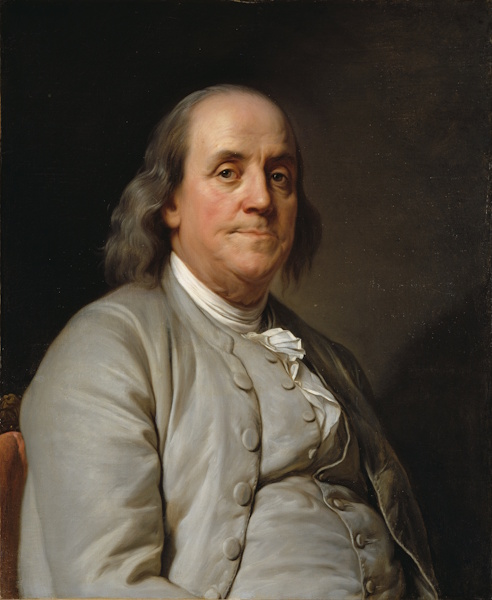
- The official portrait of Dr. Benjamin Franklin is in the Smithsonian’s National Portrait Gallery in Washington, D.C. The portrait is in the public domain. I found it on Wikimedia Commons.
- Quill photo by Joey Zhou on Unsplash. This image was taken in the Assembly Room of Independence Hall in Philadelphia, Pennsylvania. The Declaration of Independence (1776) and the U.S. Constitution (1787) were debated and signed in this room. Ben Franklin signed both documents.


